Your Customers Are Asking AI "Who's the Best Near Me?" – Here's How to Be the Answer
I’ve been building websites for local businesses since 2008. In that time the way people find you has changed maybe three times. This is the biggest one yet – and most owners I talk to haven’t clocked it.
Here’s the shift. A couple years ago, someone who needed a contractor, a dentist, an RV repair guy – whatever you do – would Google it. They’d get a page of ten blue links and a map. They’d scroll, click a few, compare. You had a bunch of chances to get noticed.
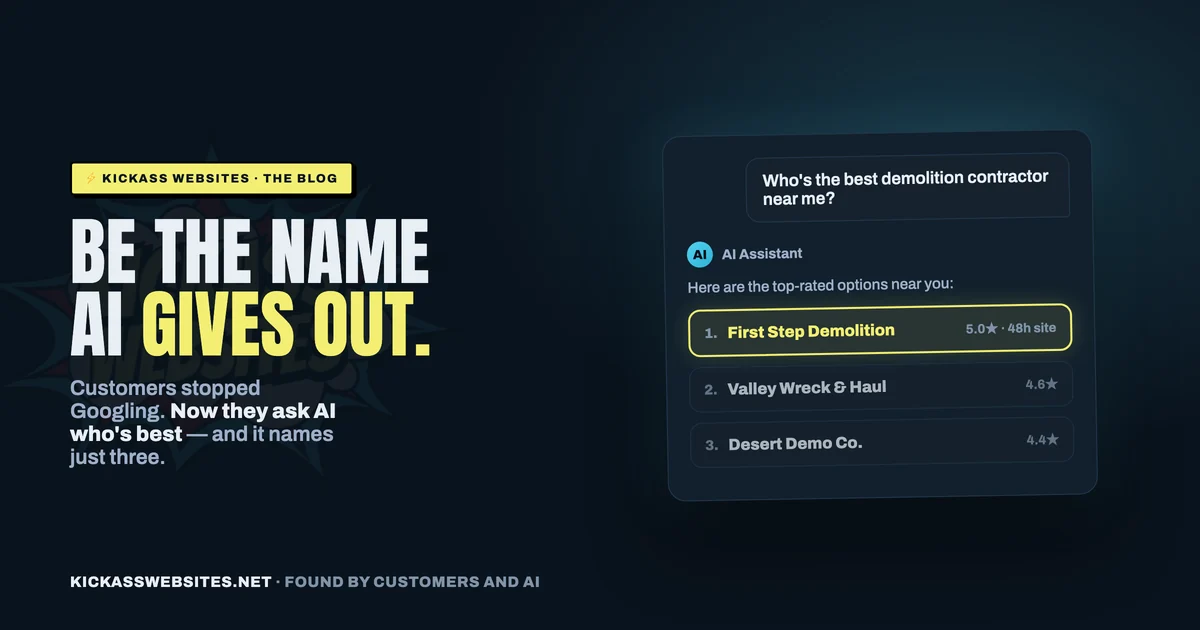
Now? A growing number of them open ChatGPT (or Claude, or Gemini, or Google’s AI answers) and type something like “who’s the best [what you do] near me?” And the AI doesn’t hand back ten links. It hands back three names. Maybe five. A clean little shortlist, like a friend giving a recommendation.
If your business is on that list, you just won the job before your competitor’s phone even rang. If you’re not – you don’t exist in that conversation. There’s no second page to claw onto. No ad slot to outbid. Just silence, and a customer who never knew you were an option.
Why this is scarier than Google ever was
With Google, being on page one was the goal, and page one had ten spots plus the map pack. Plenty of room.
AI flipped the math. When the answer is three businesses instead of ten links, every slot is worth three times as much – and three times harder to get. The shortlist got shorter, and the fight for each spot got meaner. The “worse competitor who’s just better at looking good online” problem I rail about all the time? AI makes it worse, because AI is now the one deciding who looks credible.
The good news: AI isn’t picking names out of a hat. It’s not magic. It reads. And once you understand what it reads, you can absolutely get yourself into the answer.
How AI actually decides who to name
When an AI assistant recommends a local business, it’s pulling and cross-referencing a few things. Here’s what actually moves the needle:
1. Can it read your website at all? AI doesn’t look at your site the way a person does – it reads the code, fast. A bloated template site or a sluggish builder page that takes nine seconds to load is a closed door. If the AI can’t parse what you do and where you do it in a couple seconds, it moves on to the competitor it can read. Speed and clean, structured code aren’t vanity – they’re the price of admission.
2. Is your information identical everywhere? AI tools merge data from a bunch of sources – your website, Google Business Profile, Foursquare, directories, review sites. If your name, address, phone, and services don’t match exactly across all of them, that’s a mixed signal, and mixed signals get you dropped. Consistency is boring. It’s also one of the highest-leverage things you can fix this week.
3. Do other places vouch for you? AI leans hard on third-party validation – Google reviews, Yelp, industry roundups, articles that mention you. The more real, consistent, outside signals point at you, the more confident the AI is recommending you. Reviews aren’t just for humans anymore; they’re training the machine that recommends you.
4. Are you defined as a business it can understand? This is the technical one. Structured data (schema markup / JSON-LD) is how your site explicitly tells AI “this is who I am, this is what I do, this is where I serve.” Without it, the AI is guessing. With it, you’ve handed it the answer.
What you can do this week (no website rebuild required)
You don’t have to wait on anybody to start. Here’s the honest, do-it-today list:
- Test yourself first. Open ChatGPT or Perplexity and ask “who’s the best [your trade] in [your city]?” See if you come up. That’s your baseline. (It’s a humbling thirty seconds.)
- Claim and clean your Google Business Profile. Complete every field. Right categories. Real hours. Photos.
- Make your name, address, and phone identical everywhere – your site, Google, Foursquare, every directory. Hunt down the old listing with your previous phone number and fix it.
- Ask for reviews, consistently. Not once. Make it a habit after every job.
- Make sure your website is fast and machine-readable. If it’s on a dated builder template and loads slow, that’s the leak.
The part nobody wants to hear
This isn’t a one-and-done hack. There’s no magic line of code that makes ChatGPT love you overnight. Getting recommended by AI is the same as earning a human’s trust – it takes a clean, fast, well-structured presence and consistency over time. Anyone selling you a one-click “AI SEO” button is selling you the same snake oil with a new label.
But here’s the flip side: most of your local competitors have no idea this shift is even happening. They’re still arguing about Google rankings from 2019. If you start now – fast site, clean data, real reviews, proper structure – you can be the name AI gives out while everyone else is invisible.
That’s the whole reason I build the way I build: every site we ship is fast and engineered to be read – by your customers and by the AI they now trust to pick for them.
Curious where you stand right now? You can run a free AI Visibility Report and see, in plain English, whether AI can even find you – and whether it’s naming you or handing the job to someone you’re better than.
– Steve
Stop losing jobs to better websites.
We build one that wins the call – live in 48 hours, $497, guaranteed three ways.
Get My Website Live – $497 →